Open Source
Catalog building blocks, examples, and reusable patterns for the runtime governance platform.
Open Source
The AISecOps Interceptor is the open-source runtime governance platform for agentic AI.
It is no longer just a policy gateway. The current implementation includes Runtime Governance APIs, Replay Diff Engine, Agent Identity Layer, Compliance Evidence Export, Risk Explanation Engine, MCP Policy Proxy, Local Enforcement Mode, Runtime Budgets, structured audit events, and an interactive Replay Audit UI with execution graph visualization.
Current OSS release: v1.0.0 - Replay Diff Engine + Evidence Export
Repository: github.com/viplavfauzdar/aisecops-interceptor
License: Apache 2.0
What Is Here
AISecOps Interceptor provides a framework-agnostic runtime governance layer for agentic AI systems.
It covers:
- prompt and output inspection
- local enforcement mode
- capability-gated tool execution
- agent identity validation
- provenance-aware policy enforcement
- policy enforcement
- runtime budgets
- approval-required workflows
- structured JSONL audit logging
- runtime governance APIs
- replay diff and compliance evidence export
- replayable runtime forensics
- Replay Audit UI for investigation workflows
- execution graph visualization
The project demonstrates the core AISecOps runtime model:
Agent → Plan Extraction → Capability Validation → Policy Enforcement → Runtime Budgets → Runtime Controls → Execute → Audit → Replay Diff → EvidenceThis is not a prototype. It is the working runtime core described throughout the AISecOps architecture, threat model, and enterprise governance material.
The Repository
github.com/viplavfauzdar/aisecops-interceptor ↗
- Python backend
- FastAPI runtime API
- React / Vite Replay Audit UI
- Apache 2.0 license
- Works with Python 3.11–3.13
Runtime Governance Core
AISecOps Interceptor separates planning from execution.
Instead of allowing a model or agent to directly invoke tools, the runtime constructs an explicit execution plan and evaluates it before execution.
LLM / Agent → Structured Plan Extraction
AISecOps Interceptor → Policy Enforcement + Runtime Budgets + Runtime Controls
Executor → Act
Audit Layer → Replay Diff + Evidence Export
This creates deterministic governance boundaries between:
- planning
- policy enforcement
- approvals
- execution
- replay investigation
The runtime may return:
allowblockrequire_approvaldry_runexplain
Capability-Gated Execution
Agents do not receive unrestricted tool access.
Tool execution is evaluated against explicit capability definitions before policy enforcement occurs.
Example capability patterns:
- customer read access
- infrastructure restart operations
- shell execution restrictions
- incident management workflows
- outbound communication controls
- sensitive data export limitations
This prevents agents from escalating privileges through prompt manipulation, ambiguous runtime state, or chained tool behavior.
Runtime Provenance
AISecOps tracks where instructions originate.
Runtime events may include provenance from:
- user prompts
- system prompts
- skills
- memory
- retrieval chunks
- agent messages
- tool outputs
Example provenance:
{
  "source_type": "skill",
  "source_name": "untrusted_openclaw_skill",
  "trust_level": "unverified"
}
This allows runtime investigation to answer:
What action was attempted?
Why was it attempted?
Where did the instruction originate?
Was the source trusted?
Replay APIs
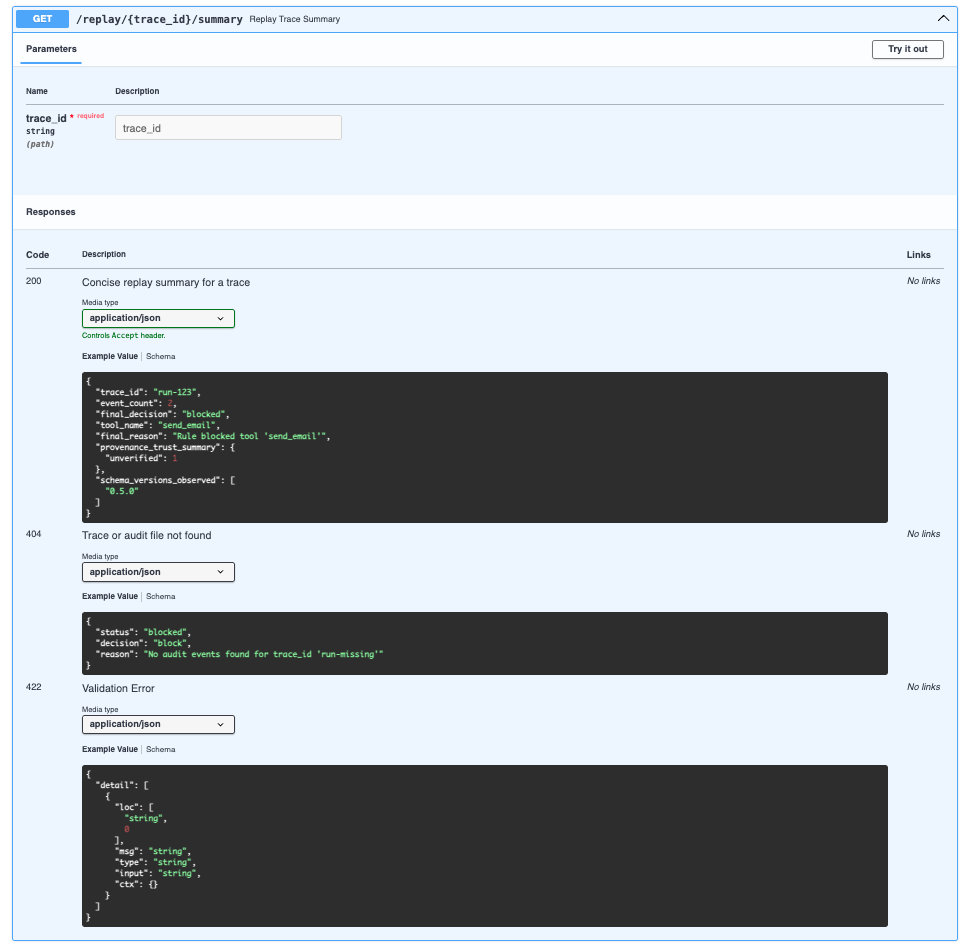
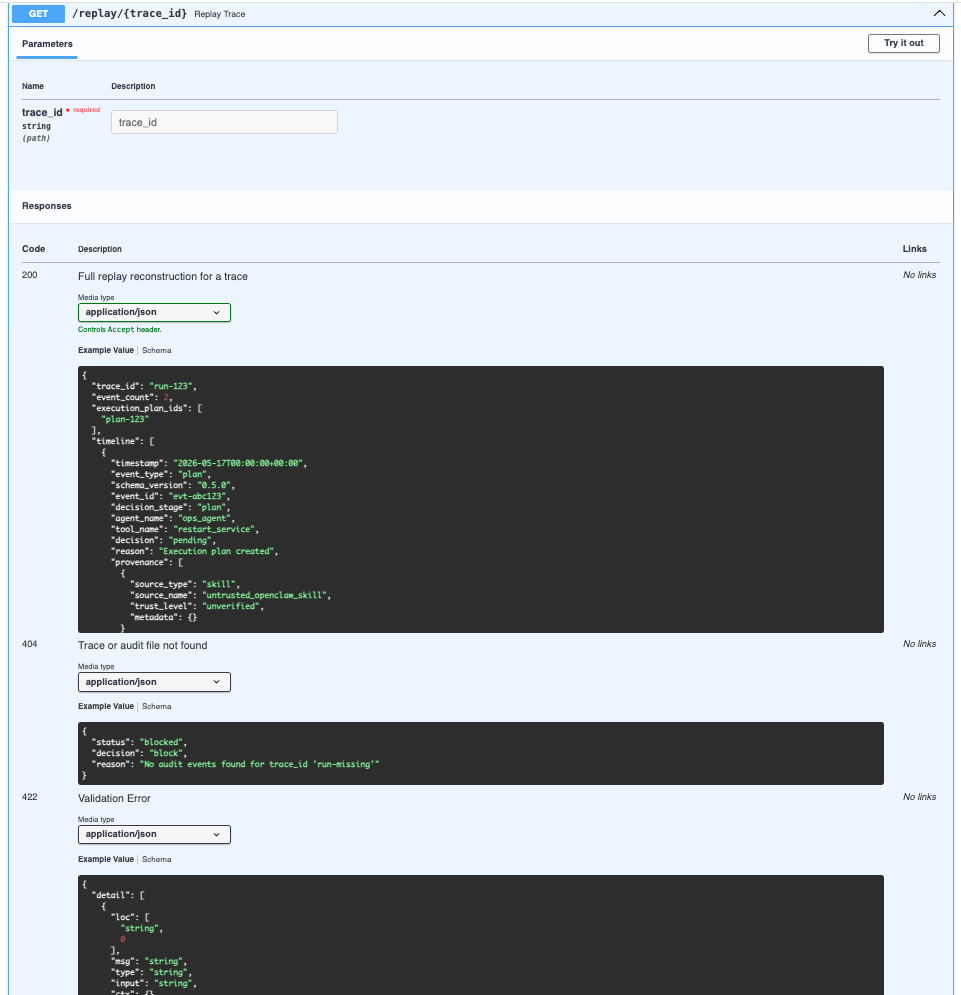
AISecOps exposes replay APIs for runtime reconstruction.
GET /replay
GET /replay/{trace_id}
GET /replay/{trace_id}/summary
Replay APIs reconstruct execution history from structured JSONL audit events.
Replay data includes:
- trace identifiers
- event counts
- final decisions
- decision reasons
- provenance summaries
- execution plan identifiers
- ordered timelines
- tool execution paths
These APIs power the Replay Audit UI, replay diff review, compliance evidence export, and future governance integrations.
Replay Audit UI
The Replay Audit UI provides runtime investigation workflows for AI agent executions.
Features include:
- replay trace list
- decision filtering
- replay timeline reconstruction
- replay diff review
- provenance badges
- raw JSON inspection
- event detail drawers
- execution graph visualization
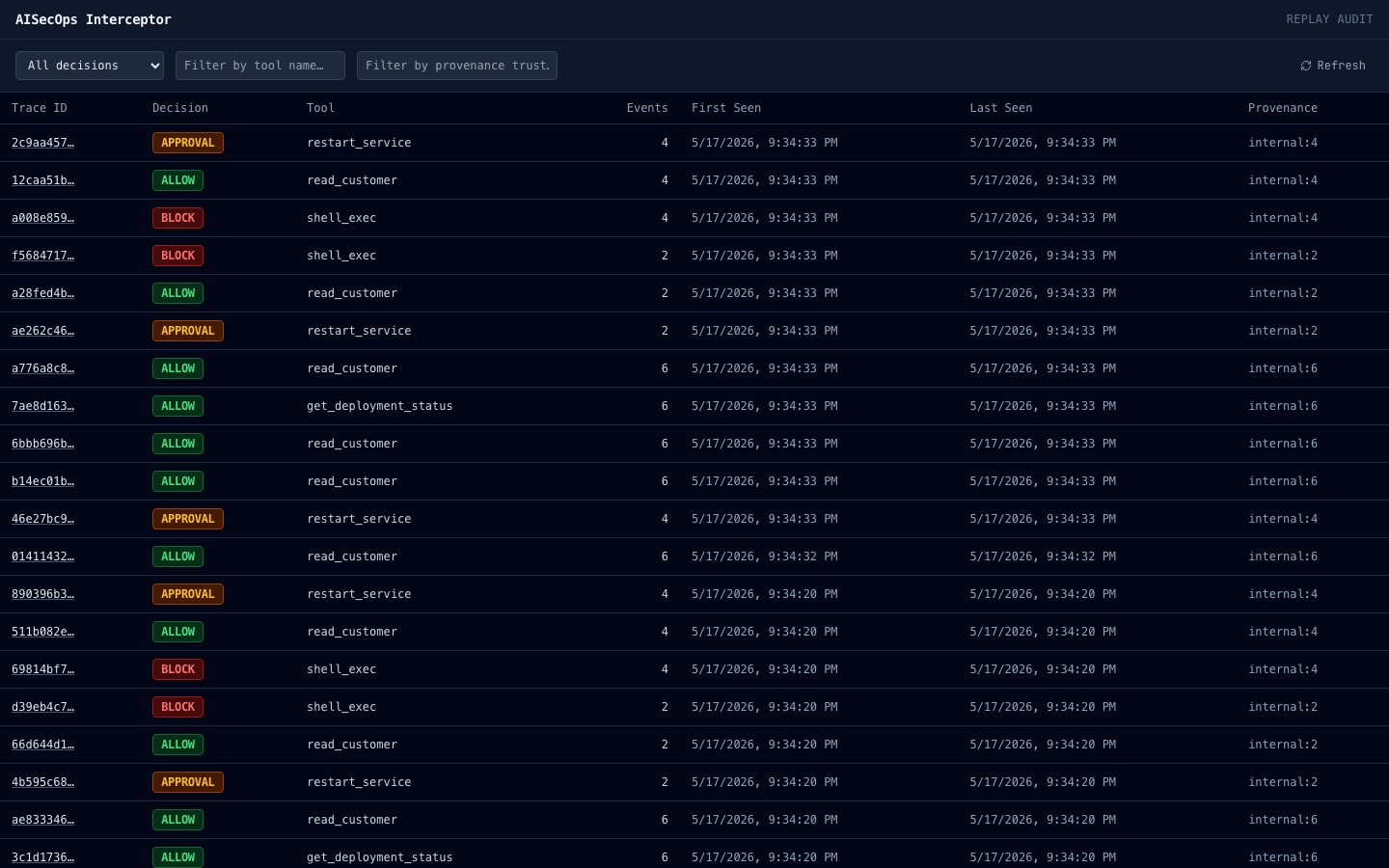
Replay Trace List
Replay summaries expose runtime decisions, event counts, provenance trust levels, and execution outcomes.
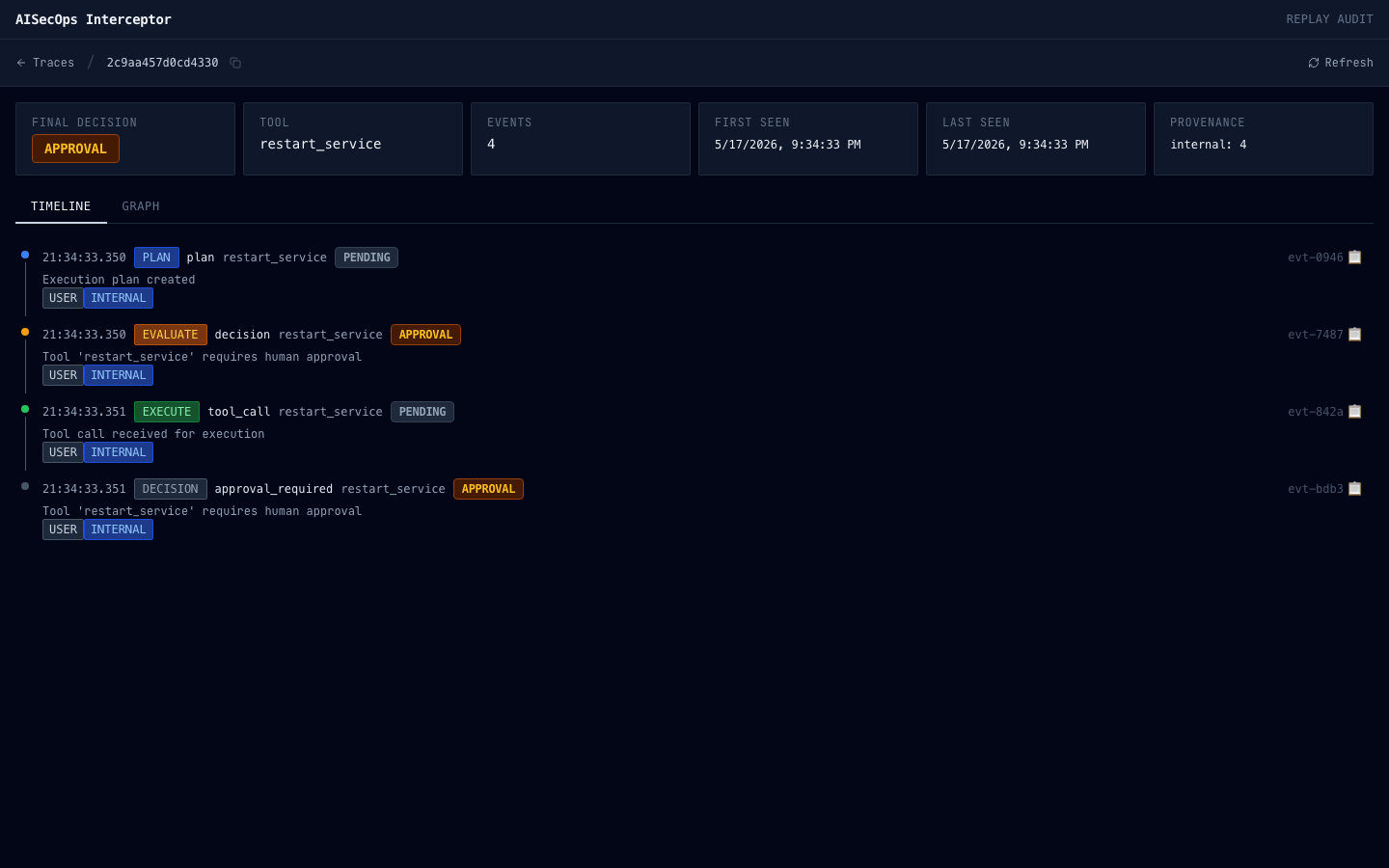
Replay Timeline
Replay timelines reconstruct planning, evaluation, approvals, execution, and final governance decisions in execution order.
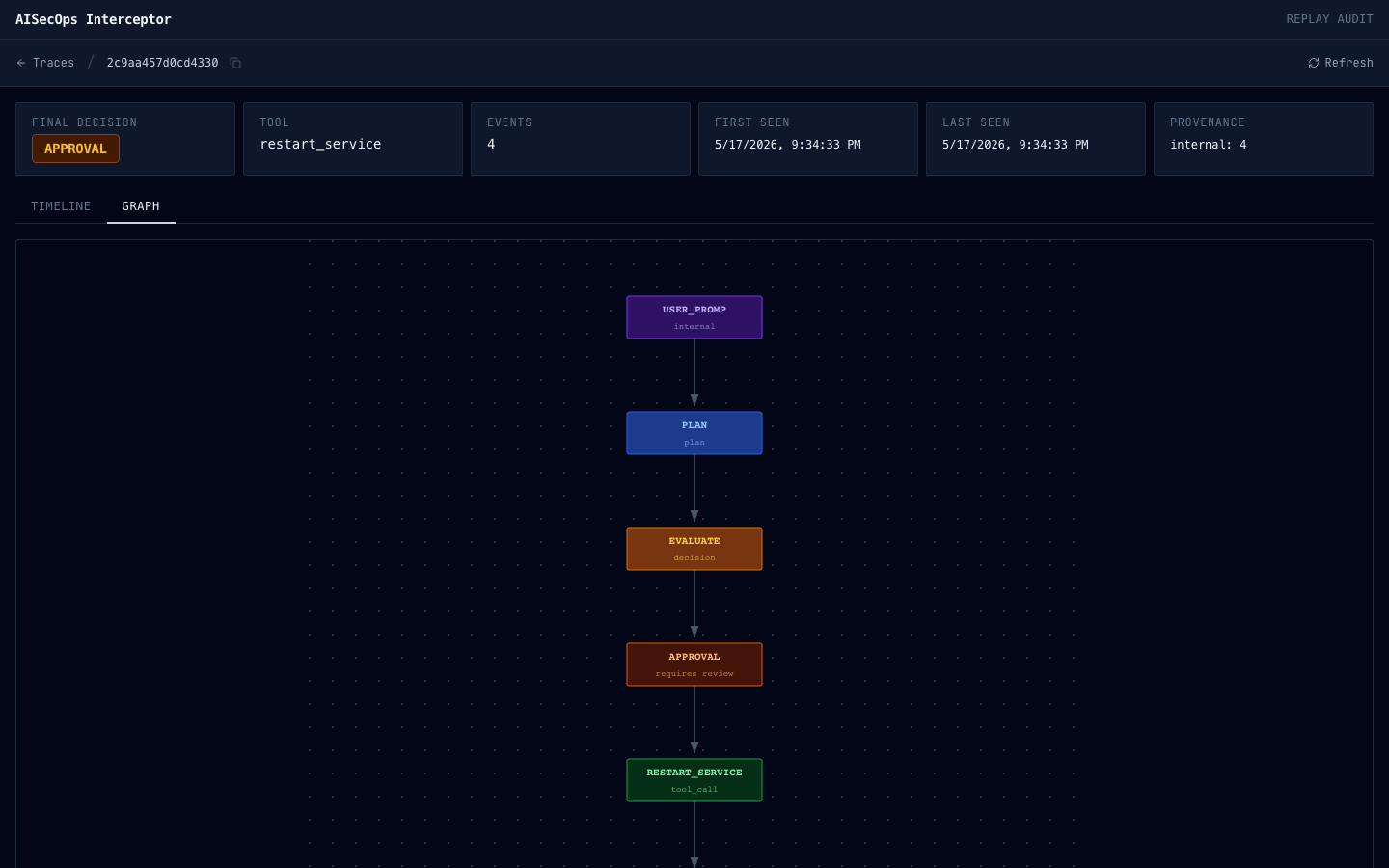
Execution Graphs
Execution graphs visualize provenance-aware runtime flow from instruction source through execution outcome.
Structured Audit Events
AISecOps emits structured runtime events for replay and investigation.
Audit events include:
schema_versionevent_idtrace_idexecution_plan_idevent_typedecision_stageagent_nametool_namedecisionreasonprovenancetimestamp
This makes audit events usable as replayable forensic evidence rather than passive application logs.
Swagger API Surface
The FastAPI API exposes interactive Swagger documentation for local testing and runtime demonstrations.
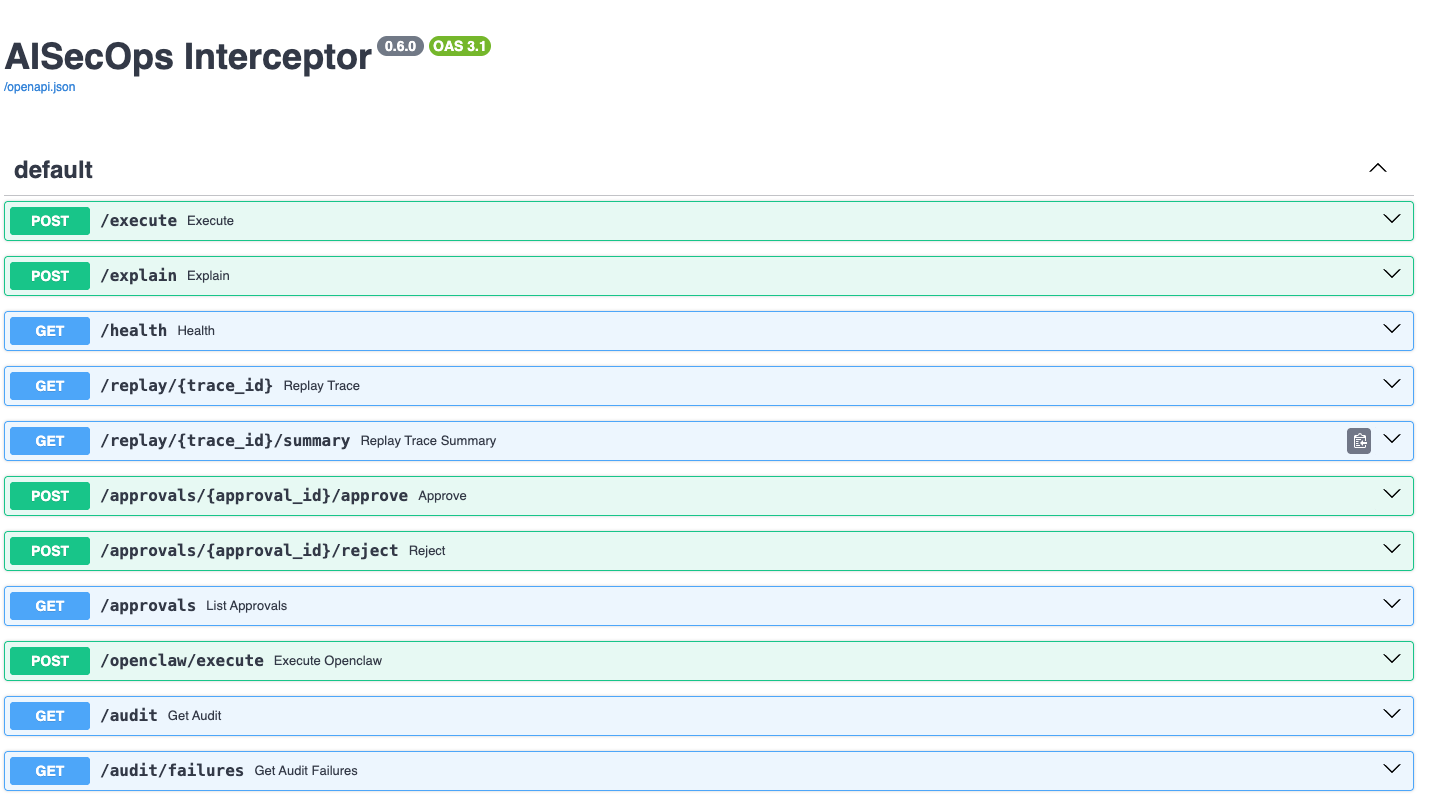
Replay endpoints are also exposed through Swagger, including trace replay and replay summary APIs.
Quick Start
# create environment
python3.13 -m venv .venv
source .venv/bin/activate

# install dependencies
pip install -r requirements.txt

# run tests
pytest -q

# run API
uvicorn aisecops_interceptor.api.main:app --reload

# run dashboard
cd dashboard
npm install
npm run dev
Python 3.11 through 3.13 supported.
Policy Bundle Example
Define runtime governance policy in YAML:
rules:
  - tool_name: restart_service
    agent_name: ops_agent
    action: require_approval

  - tool_name: read_customer
    sensitivity_level: high
    action: block

  - tool_name: send_email
    action: require_approval
Load at runtime:
policy = PolicyEngine.from_yaml("policies/production.yaml")Bundles are validated before runtime execution.
Repository Structure
aisecops_interceptor/

  core/           interceptor, policy, approval, audit,
                  context, decision, execution, events

  replay/         replay engine, trace reconstruction,
                  replay summaries

  guard/          detectors, input inspector, output inspector

  llm/            providers, pipeline, config, models

  policy/         rule engine, schema, loader

  integrations/   LangGraph adapter, OpenClaw adapter

  api/            FastAPI runtime APIs

  dashboard/      Replay Audit UI + execution graphs
Framework Integration
The interceptor integrates with any agent framework through thin adapters.
Current integrations:
- LangGraph-style
- OpenClaw-style
- generic runtime adapters
flowchart LR

A[LangGraph]
B[OpenClaw]
C[CrewAI / AutoGen]
D[Custom Runtime]

A --> E[Adapter]
B --> E
C --> E
D --> E

E --> F[AISecOps Runtime Core]
F --> G[Replay + Governance Layer]
Why This Matters
AI agents are moving from chat systems to execution systems.
They can:
- call tools
- access APIs
- query internal systems
- trigger workflows
- send messages
- modify infrastructure
- interact autonomously with enterprise environments
Traditional application logging is insufficient for understanding runtime agent behavior.
AISecOps is designed to make runtime behavior:
- governable
- replayable
- explainable
- attributable
- inspectable
- auditable
The goal is not only to block unsafe actions.
The goal is to reconstruct:
what happened,
why it happened,
and where the instruction originated.
What Is Coming Next
Current roadmap focus:
- richer execution graph analysis
- replay comparison across policy versions
- signed provenance and trust registries
- distributed trace reconciliation
- policy drift detection
- deeper agent framework integrations
- enterprise deployment patterns
V
Viplav Fauzdar
Building AISecOps as a discipline and open-source runtime governance reference implementation. Focused on practical, shipped security for agentic AI systems.